
Figma closed down 7.28% on April 17. Adobe dropped 2.7%. Wix fell 4.7%. The market took one look at Anthropic’s new product and decided an entire design tooling category was in trouble. That product was Claude Design — a UI where you describe what you want and Claude builds it, refines it, and hands it off. Impressive. Worth the stock reaction? Probably. But here’s the part nobody said out loud: Claude Code users were already doing this.

What Anthropic actually shipped on April 17
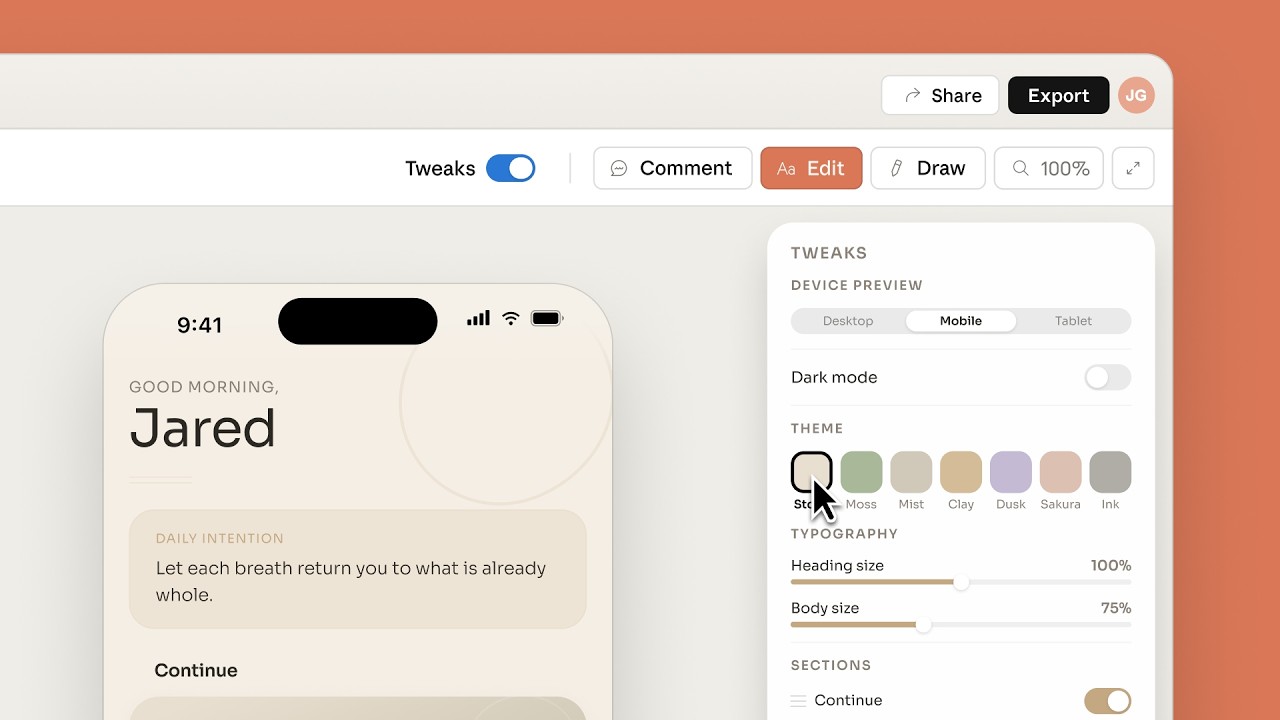
Claude Design launched as an Anthropic Labs product, powered by Claude Opus 4.7. You import from a prompt, image, document, or website. Claude builds a first version. You refine it with inline comments, direct edits, or sliders. Output goes to Canva, PDF, PPTX, HTML — or handoff to Claude Code.
That last export target is the tell. Claude Design exporting to Claude Code isn’t a cute feature. It’s Anthropic quietly admitting that Claude Design is a front end for a pipeline Claude Code already runs. The Datadog quote in Anthropic’s own announcement is the thesis statement: “What used to take a week of back-and-forth now happens in a single conversation.”
Brilliant said complex pages that needed 20+ prompts elsewhere took 2 in Claude Design. Also true. Also — and this matters — the reason it only takes 2 prompts is that the engine underneath is the same one Claude Code users have been composing by hand since late 2025.

The pipeline I’ve been running for months
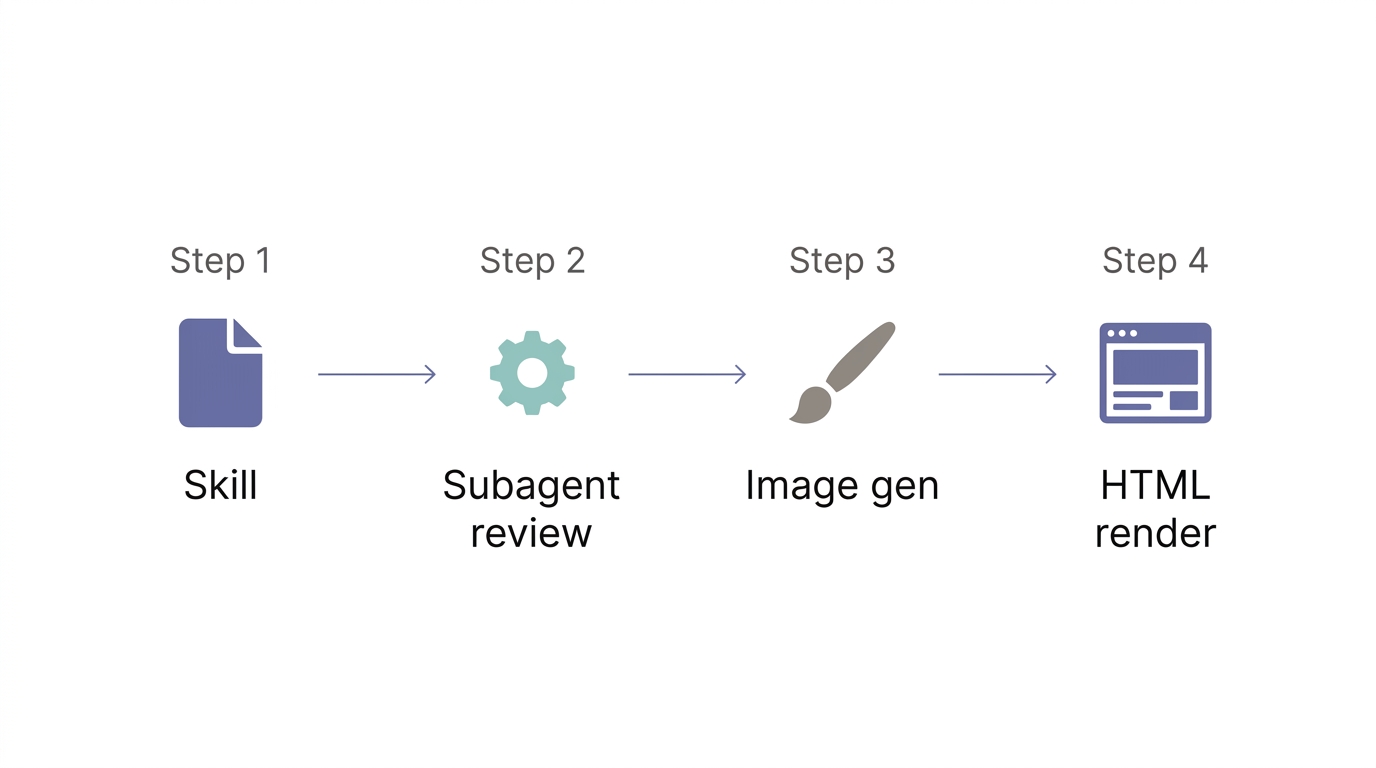
The single image on the LinkedIn post that kicked off this blog was generated end-to-end from my terminal. One skill file. One subagent. One Gemini call. One HTML screenshot. Total time: under three minutes.
The skill lives at .claude/skills/create-post-designs/SKILL.md. It’s four things:
- A SKILL.md — the playbook. Fetches brand docs, picks a format, writes Gemini prompts, runs a text-verify loop, uploads outputs, updates ClickUp.
- A design-reviewer subagent — scores brand match, layout, and visual impact. Rejects and asks for a regen when something’s off.
- Gemini 3.1 Flash Image (Nano Banana 2) for the creative pass, plus Gemini 2.5 Flash for typo verification and auto-fix.
- Puppeteer + HTML for the final text pass. Gemini handles composition. HTML handles letters. The two layers solve the rendering problems image models are bad at.
None of this was clever. The Gemini API has been public since 2024. SKILL.md has been a formal Anthropic spec since December 18, 2025, with 25+ compatible implementations inside 12 weeks. Subagents shipped with Claude Code’s agent system last fall. Every piece of the stack has been sitting on the shelf. I just composed them.
I wrote up the skills discovery itself last year in I Thought Claude Skills Were Just Fancy Prompts. They’re Actually Better. — the TL;DR is that SKILL.md plus a resources/ folder plus a scripts/ folder gives you more control than any hosted UI, because you own every layer.
Why the Claude Design launch is really onboarding
The hot take on Figma’s stock drop was “design tools are dead.” That’s wrong. Design tools aren’t dying. They’re getting a new bottom end.
For the person who was never going to touch a terminal — the PM, the founder, the marketer — Claude Design is suddenly the most capable design tool they’ll ever have used. It reads their codebase. It applies their design system automatically. It exports to Canva and handoffs to Claude Code. That’s real. That’s a big deal.
For me, and for anyone else already composing from Claude Code primitives, it’s a UI on top of what I was already running. The engine — skills as procedure, subagents as review, Gemini as brush, HTML as printer — doesn’t change. Anthropic just wrapped it, priced it, and handed it to people who don’t want to wire four APIs together on a Tuesday night. Both things are true.
The bigger shift: three tools become one conversation
The part of the Anthropic announcement that should scare Figma more than the share price is the workflow it implies. Design, spec, and implementation used to be three tools and two handoffs. Designer ships a Figma file. Engineer rebuilds it in code. PM argues about the gap. Every step loses information.
Claude Design collapses that to one conversation. Same underlying design system. Same exported code. Same refine loop. The handoff disappears because there isn’t one.
This isn’t just Anthropic. My 4-agent Claude Code content pipeline runs the same collapse for writing and publishing — strategist plans, creator drafts, critic reviews, publisher ships. The difference is scope. Claude Design does visuals end-to-end. You can do that for anything if you compose the skills yourself.
What this means for builders right now
Two things if you already live in Claude Code:
- The Claude Design launch is free PR for the underlying pattern. Clients who rolled their eyes at “but it’s just markdown files” suddenly get it, because Anthropic gave the pattern a UI and the market priced it. Use that.
- The UI wrappers are coming for every workflow. Not just design. Expect “Claude Research,” “Claude Ops,” “Claude Support” — each one productizing what power users already compose. The skill that writes this blog is the same pattern. If you build the skill once, you own the engine when the UI shows up.
If you haven’t built a skill yet, start with one you use weekly. Put it in .claude/skills/<name>/SKILL.md. Add a subagent for review. Wire one external API. That’s the whole pattern Anthropic just put a UI on.
FAQ
What is Claude Design?
Claude Design is an Anthropic Labs product launched April 17, 2026 that lets users create prototypes, slides, and marketing visuals through conversation. It’s powered by Claude Opus 4.7 and exports to Canva, PDF, PPTX, HTML, or a direct handoff to Claude Code.
Why did Figma stock drop on the Claude Design launch?
Figma (NYSE: FIG) closed down 7.28% on April 17, 2026 — from $20.32 to $18.84. Investors read Claude Design as a direct threat because it does prototypes, design systems, and code export in one tool, collapsing a multi-step workflow Figma has historically anchored.
Can Claude Code do what Claude Design does?
Yes, if you compose the primitives yourself. A skill file, a review subagent, an image model like Gemini 3.1 Flash Image, and HTML for pixel-perfect text covers the same generate-verify-refine loop. Claude Design is the UI-friendly version; Claude Code gives you more control in exchange for the setup work.
Start here: open .claude/skills/ in your own repo, create a SKILL.md for the one design task you do most, and run it once. Composing the pattern yourself is the fastest way to see what Claude Design is actually wrapping — and to build everything else that doesn’t have a UI yet.