
Volume made coordination the real bottleneck
At a few campaigns per month, a person can carry the process in their head. At roughly 209 approvals per month across multiple client brands, the handoffs become the work.
Every campaign needs the right context. The brief has to reflect the client, the offer, the audience, and the approved idea. Email and SMS drafts have to stay aligned with that brief. The next person needs a clear task and the right material. If something fails, the team needs to know where it stopped.
The goal was not to remove people from marketing. It was to stop making people repeat the mechanical preparation work between an approved idea and a reviewable draft.
Human approval became the start signal
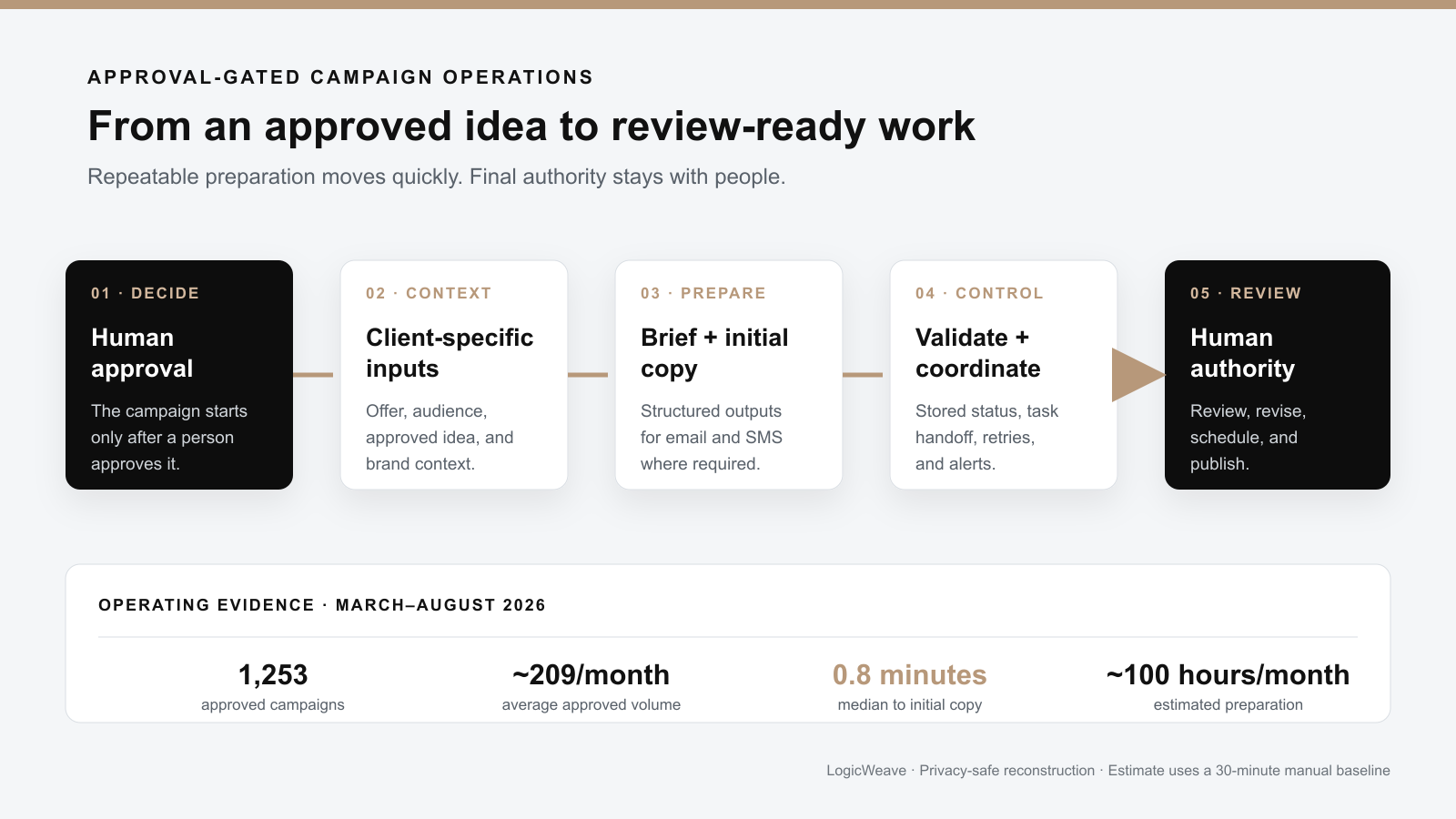
The workflow begins only after a person approves the campaign. That status change is the operating signal—not a loose prompt and not an autonomous content calendar.
From there, the system gathers the relevant client context, prepares the brief, creates initial email and SMS copy where required, checks the result, records the delivery state, and coordinates the next task. Operational alerts make a failed step visible so the team can intervene instead of assuming the campaign is ready.
This creates a clean division of responsibility: the system handles repeatable preparation and routing; people retain campaign approval, editorial judgment, revision, scheduling, and publication authority.
The system carries context forward instead of starting over
Speed alone would not make this useful. A fast generic draft would simply move the burden to the reviewer.
The workflow uses the approved campaign and client-specific material to create a structured brief before producing copy. That brief becomes a shared contract between the idea, the generated draft, and the person reviewing it. Validation steps check the output before it moves downstream, while task coordination keeps the work attached to the operating process the team already uses.
The result is not one large autonomous agent. It is a series of bounded steps with an explicit start condition, stored outputs, visible state, retry behavior, and a human decision at the end.
The measured result was preparation speed at operating volume
From March through August 2026, 1,253 campaigns reached approved status—an average of 208.8 per month. For campaigns with generated copy, the median time from approval to the initial copy record was 0.8 minutes. The corresponding median for a generated brief was 0.4 minutes.
Those numbers measure system preparation time. They do not measure how long a person spends reviewing or revising the work, and they do not prove campaign performance. What they show is that the repetitive first-draft handoff can happen quickly and consistently enough to support a real monthly workload.
~100 hours per month is a planning estimate, not a payroll claim
To make the capacity easier to understand, I used a conservative planning assumption of 30 minutes for a person to assemble a campaign brief and initial copy manually.
Publicly rounded to ~100 hours/month estimated.
That estimate is intentionally bounded. The manual baseline was not measured in a formal time study. It does not include review, revision, scheduling, or publication, and it should not be read as verified payroll savings or ROI. It is a transparent estimate of the repetitive preparation capacity handled by the workflow.
Guardrails made the speed usable
- Nothing starts until a person approves the campaign.
- Client context and the approved idea travel into the brief and copy steps.
- Validation occurs before generated material is treated as ready for review.
- Stored status makes the campaign’s place in the workflow visible.
- Retry and alert paths surface operational problems.
- Generated material remains a draft until a person reviews and approves it.
That last boundary matters most. The system accelerates the path to a decision; it does not make the final marketing decision.
What this case study proves—and what it does not
This case study shows that an approval-gated workflow can coordinate research, briefs, first-draft copy, validation, and task handoffs at meaningful monthly volume. The live operating data supports the approval count and the measured time to generated records.
It does not claim better conversion rates, revenue growth, deliverability, or a measured reduction in payroll. Those outcomes would require separate evidence.
The useful lesson for another company is straightforward: choose a clear human decision as the trigger, automate the repeatable preparation around it, make failures visible, and keep final authority with the people accountable for the result.
Frequently asked questions
Does the system publish campaigns automatically?
No. It prepares and coordinates draft material. A person retains final review, revision, scheduling, and publication authority.
Is the ~100-hours-per-month number measured savings?
No. It is a planning estimate based on 208.8 monthly approvals and an assumed 30 minutes of manual brief-and-first-draft preparation per campaign. The case study states that assumption directly.
Does the 0.8-minute median include human review?
No. It measures the elapsed time from campaign approval to an initial generated copy record for campaigns with copy. Review and revision happen afterward.