
Codex vs Claude Code: The UI Is the Difference
Codex vs Claude Code is less about raw intelligence and more about workflow. Codex feels better when you are juggling real projects.
 Collin GatesJun 25, 20267 min read
I did not expect my answer to Codex vs Claude Code to be this boring.
I thought I was going to write a model comparison. Which one fixes bugs faster. Which one writes cleaner tests. Which one is more likely to get stuck in a loop and start apologizing to itself.
After using both, that is not the piece I want to write.
Claude Code is still excellent. I am not throwing it away. But Codex feels better right now for one specific reason: it is easier to manage the work.
Not the prompt. Not the model. The work.
When I have one coding task open, Claude Code and Codex are in the same fight. When I have five projects, three background tasks, a blog draft, a ClickUp automation, and one thread waiting for review, Codex starts to feel less like a chatbot and more like a workspace.
That is the difference I care about.
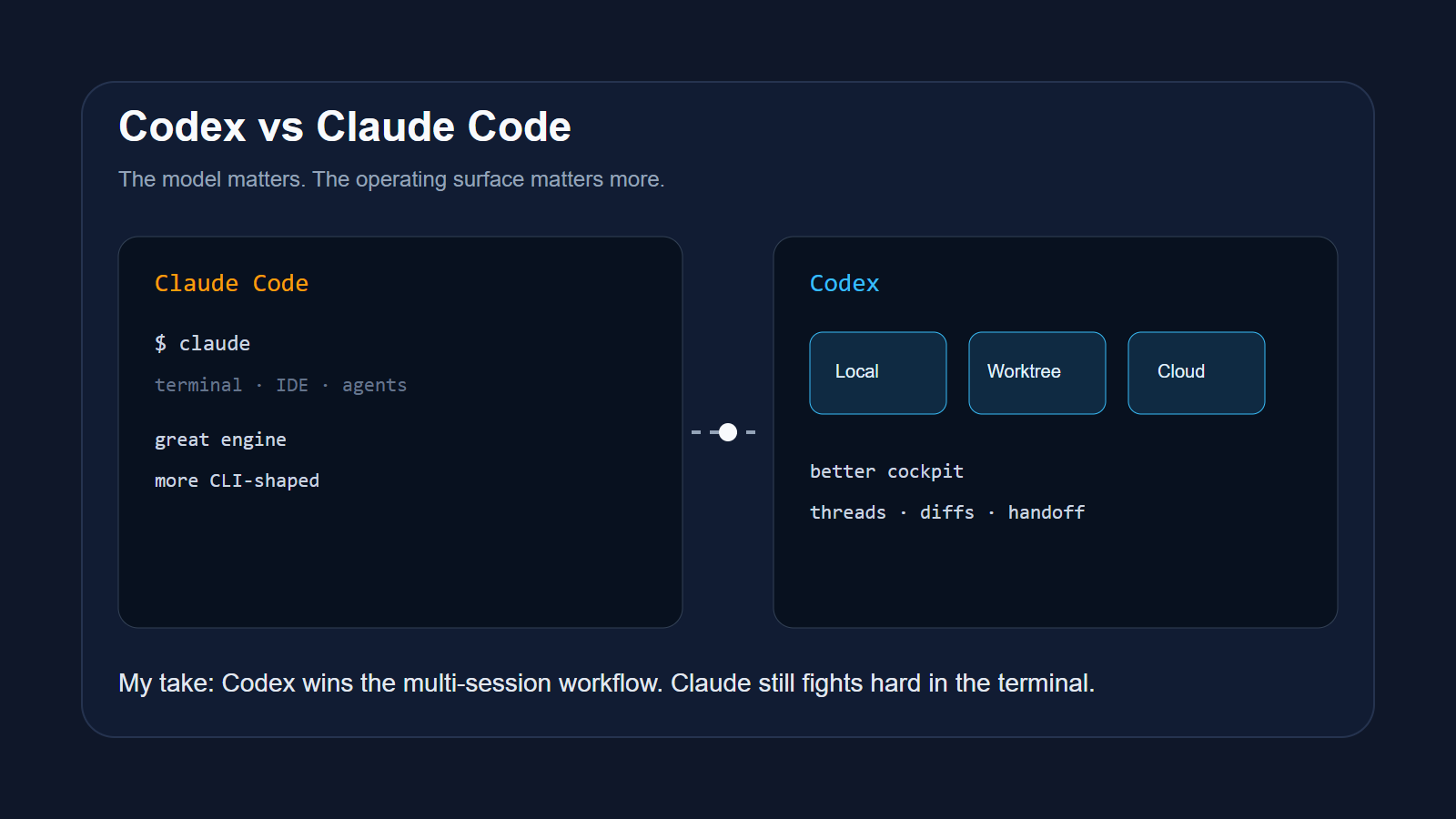
Codex vs Claude Code is really a workflow comparison
Both tools can read a repo, edit files, run commands, and help you ship code.
Anthropic describes Claude Code as an agentic coding tool available in the terminal, IDE, desktop app, and browser. It can edit files, run commands, and work across a project. That is the core job, and Claude is good at it.
OpenAI’s Codex docs describe a similar coding-agent surface, but the desktop app has a stronger organizing layer around it: projects, threads, local mode, worktree mode, cloud mode, built-in Git review, an integrated terminal, automations, and thread management.
That sounds like product documentation until you actually use it. Then it becomes the whole game.
I do not want one genius terminal session anymore. I want a board of active work. I want to know which repo a thread belongs to, whether it is touching my local checkout or an isolated worktree, what changed, what still needs review, and whether I can hand the work back into my foreground environment without turning my Git state into soup.
That is where Codex feels ahead.
Where Claude Code still feels stronger
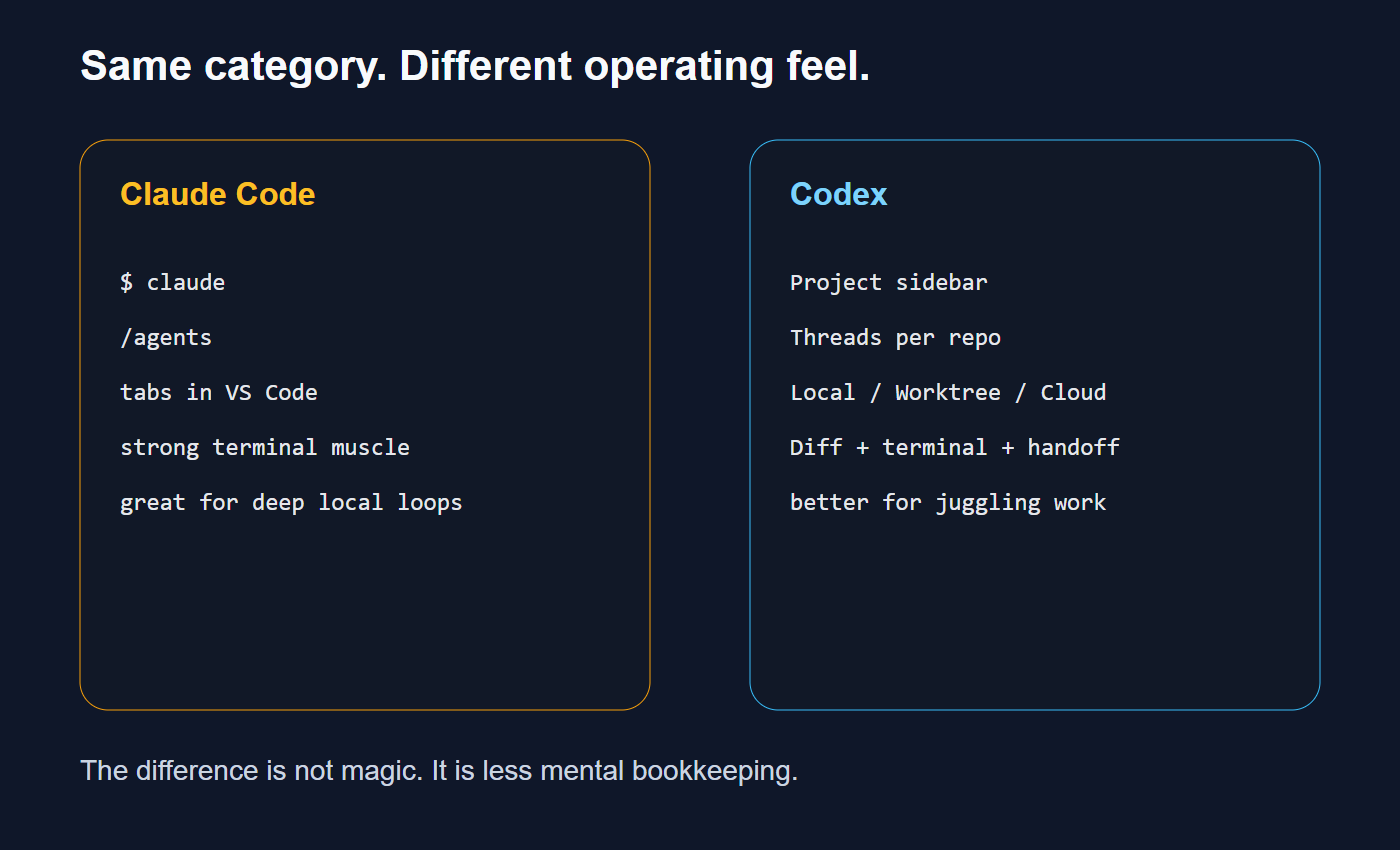
Claude Code still has the terminal-native feel.
If I am deep inside one repo and want to stay in the shell, Claude Code is comfortable. The CLI is mature. The VS Code integration has useful context controls, session history, multiple conversations in tabs or windows, and visible status dots when a hidden tab needs permission or finishes.
The subagent story is also strong. Claude Code’s /agents interface lets you create and manage subagents, choose scope, configure tools, pick models, and set memory. The Running tab shows live and recent subagents. The Library tab gives you a real management surface for agent definitions.
That matters.
If your workflow is “I live in the terminal, I know exactly which repo I am in, and I want a coding agent to grind through the current task,” Claude Code is still a serious default.
I also think Claude Code made a lot of the industry comfortable with agentic coding in the first place. The muscle memory is real. The ecosystem is real. I have built around it.
So this is not a “Claude is dead” post. It is more annoying than that.
Claude is good enough that the comparison moved up a layer. The question is no longer “can the agent code?” The question is “can I manage the agent work without losing track of my actual projects?”
Where Codex feels better right now
Codex wins the cockpit test.
The app makes projects and threads visible. A thread can run against the local checkout, an isolated Git worktree, or a cloud environment. The diff pane is in the same product. The terminal is in the same product. Git actions are in the same product. Automations can wake up a thread on a schedule.
None of those features are individually shocking. Together, they reduce the amount of mental bookkeeping.
That is what I underestimated.
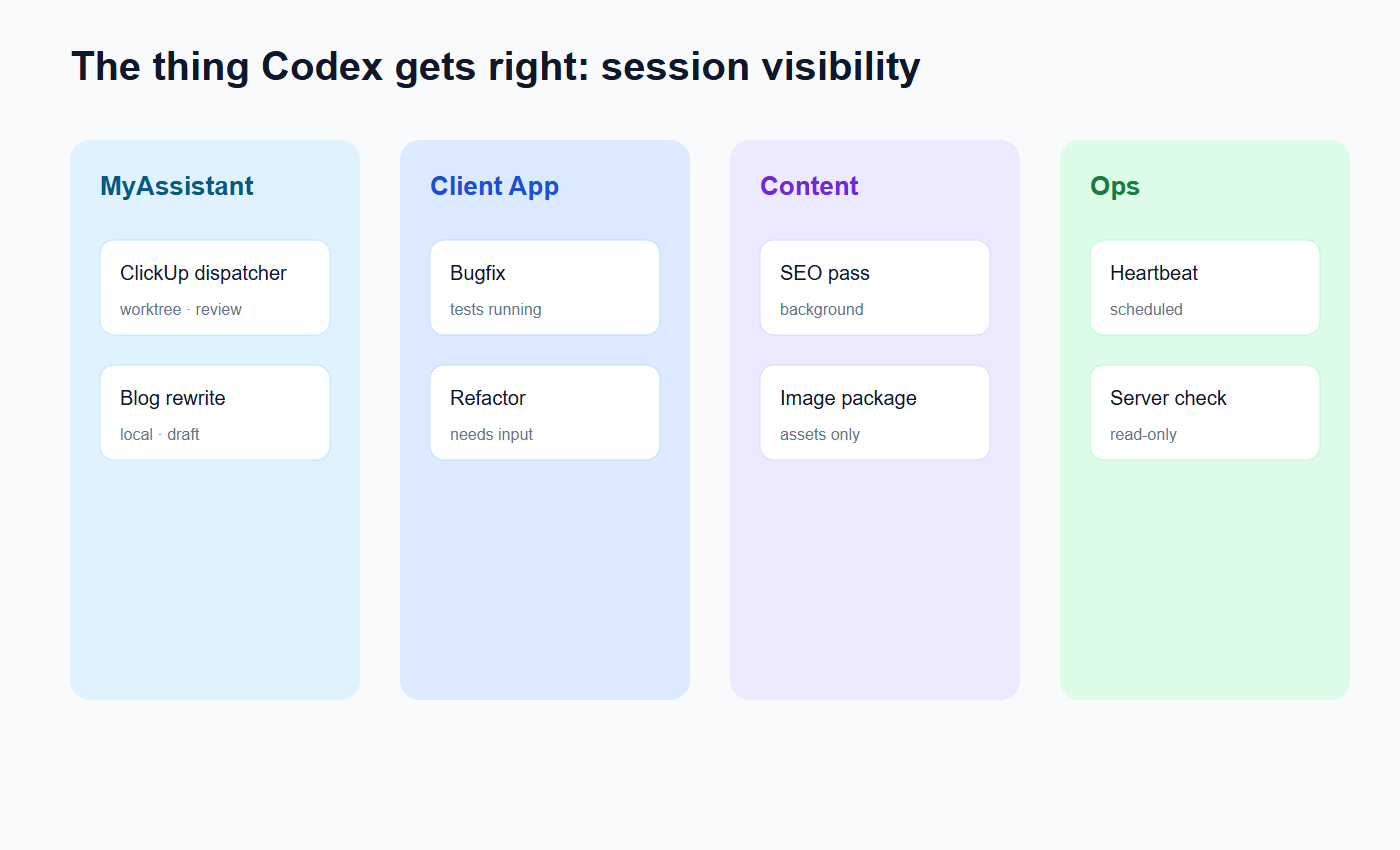
In the last few days, I have had Codex working across my personal assistant repo, a ClickUp dispatcher workflow, content artifacts, and project-specific implementation tasks. Some of that work should touch local files. Some should sit in a worktree. Some should only inspect state and report back. Some should run every few minutes as a heartbeat.
The Codex interface makes those differences visible enough that I can operate them.
With Claude Code, I can get there, but I feel like I am assembling the operating layer myself. Terminal sessions, background agents, custom dashboards, Visual Studio Code tabs, external task tracking. All workable. All familiar. But more glue.
Codex feels like someone decided the glue deserved a UI.
Worktrees are the boring feature that changes the feel
The Codex worktree flow is the part that sounds small and then changes how you work.
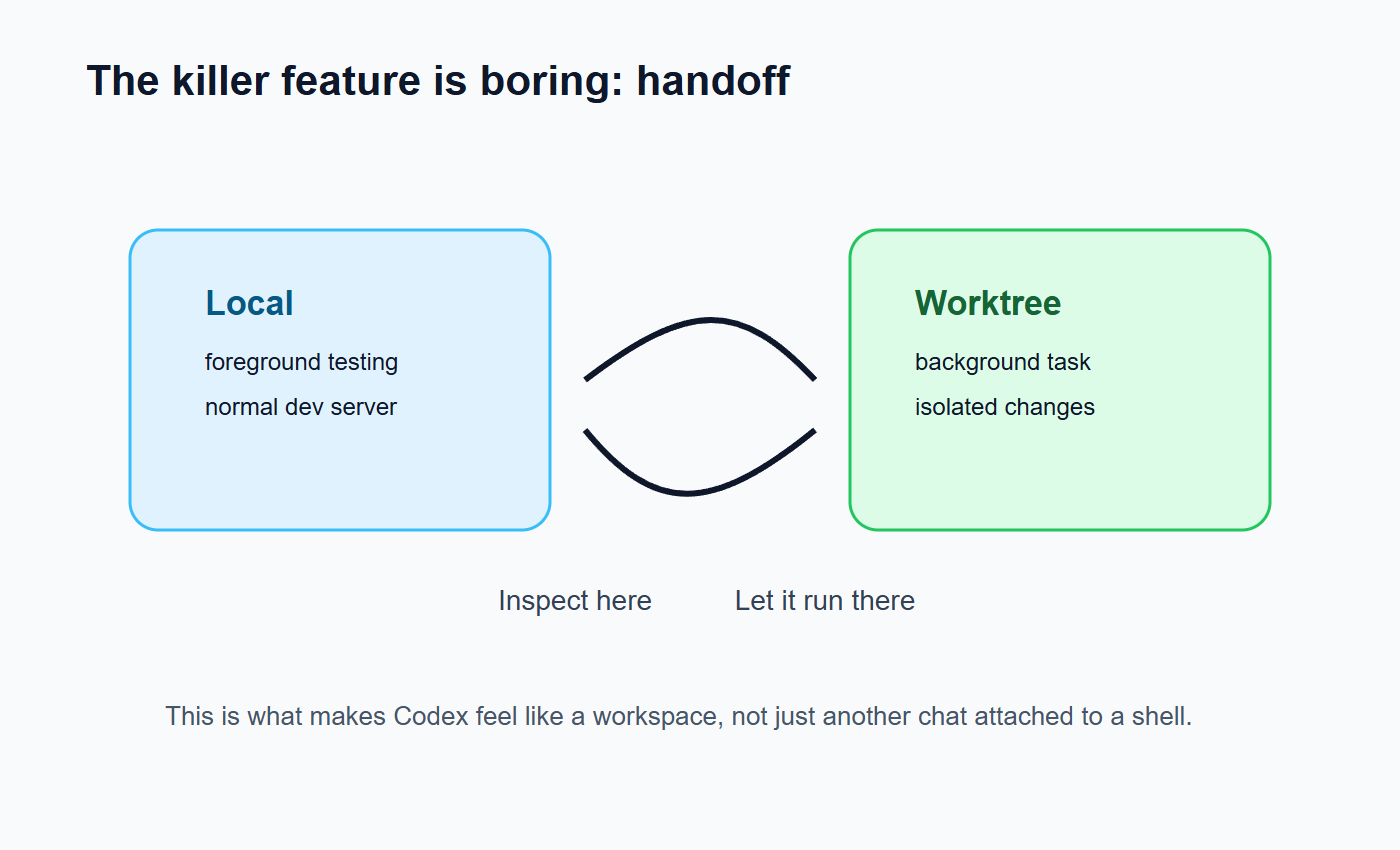
The docs frame Local as the foreground and Worktree as the background. That is exactly right. Local is where I inspect, test, and collaborate directly. Worktree is where I let a thread try something without disturbing the main checkout.
The handoff behavior matters because it keeps the thread and code together while moving between those environments. If I want Codex to keep working in the background, I can move it to a worktree. If I want to inspect the changes in the same environment I use every day, I can bring it back local.
This is not glamorous. It is Git hygiene with a button.
But most agent disasters are not glamorous either. They are boring state problems:
- Which branch is this on?
- Did it touch my dirty local files?
- Which task owns this diff?
- Can I run the app here?
- Did I just start two agents against the same checkout?
Codex does not magically solve every one of those problems. You still need discipline. But the product shape pushes you toward cleaner separation.
That is a real advantage.
The honest verdict
My current take:
- For one deep terminal-heavy coding loop, Claude Code is still excellent.
- For managing multiple coding sessions across multiple projects, Codex feels better.
- For teams, the winner is probably whichever tool gives you clearer review, ownership, and rollback.
- For my workflow right now, Codex is winning because the UI reduces chaos.
That last sentence is the article.
I do not think Codex is obviously smarter than Claude Code. I do not think Claude Code suddenly stopped mattering. I think Codex made the management layer feel first-class.
That is what changed my behavior.
I can keep one thread rewriting a blog, another checking a ClickUp task, another isolated in a worktree, and another waiting for review. I can pin what matters, archive what is done, and come back to the work without reconstructing the whole state from terminal scrollback.
That is not a benchmark. It is better than a benchmark for how I actually work.
What I would choose today
If you are a developer who lives in the terminal, start with Claude Code. You will probably like it, and the subagent system is worth learning.
If you are juggling client repos, internal automations, content systems, and long-running implementation threads, try Codex seriously for a week. Not for one task. A week.
The difference only shows up when the work gets messy.
That is the trap with these comparisons. A clean benchmark task makes every coding agent look like a slightly different flavor of the same product. Real work is not clean. Real work is five half-finished threads, one failed test, a reviewer comment, an uncommitted local change you forgot about, and a client task that should not be touched until approval.
In that world, UI is not decoration.
UI is control.
FAQ
Is Codex better than Claude Code?
For raw coding ability, I would not make a universal claim. For managing several active coding sessions across projects, Codex currently feels better to me because the app exposes projects, threads, worktrees, diffs, terminal output, and automations in one place.
Should developers switch from Claude Code to Codex?
Not automatically. If Claude Code fits your terminal or IDE workflow, keep using it. If your pain is managing many sessions, worktrees, review states, and background tasks, Codex is worth testing.
What is the biggest Codex advantage in 2026?
The biggest advantage is the operating surface. Local, Worktree, and Cloud modes make it easier to separate foreground work from background agent work, and thread management makes it easier to keep track of what is happening.
What is the biggest Claude Code advantage?
Claude Code still feels very strong for terminal-native development and configurable subagents. Its /agents workflow and IDE integrations are mature enough that developers who already live there may not feel a strong reason to move.